
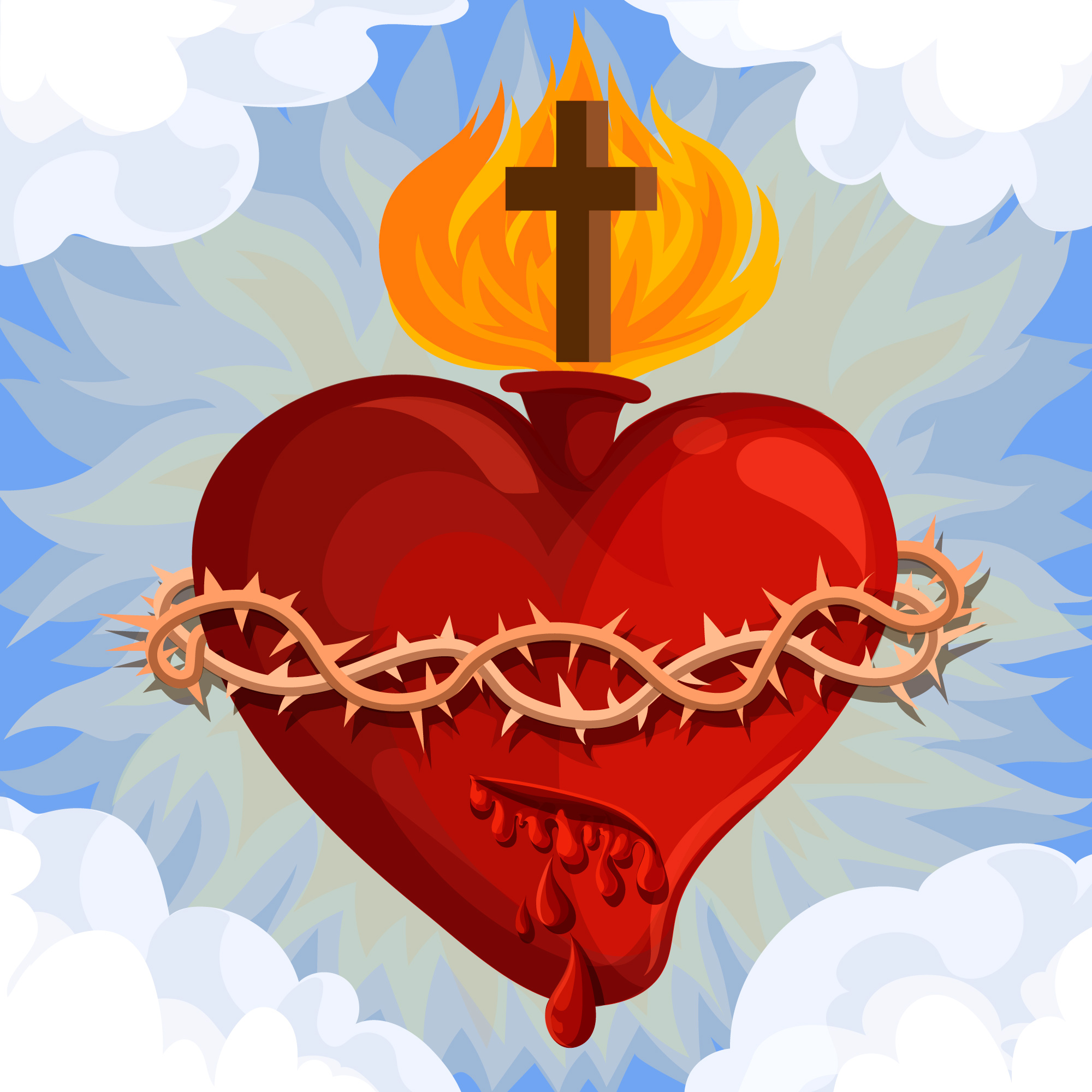
Jesus Christ is Love. Many of us have heard this throughout our lives, maybe to the point where we take its significance a bit for granted. The meaning behind this could never be fully explained in human words but as the author of this essay, humor me while I try to attempt to explain thoroughly yet concisely my interpretation of this truth and way of life, all while citing references from the Catechism of the Catholic Church.
I will first start by describing what love can be described as according to the Catholic Church, as well biblical and everyday examples of this love. Then I’ll move onto how Love is the principal theme behind all that we were made to do and how this shows in the Ten commandments and Christ, our Lord’s new covenant. And lastly, I’ll conclude with how Love is seen in the world today, through its fulfillments, its misconceptions, and its impact on our earthy lives, as well as eternal lives.
So, what is Love? Many would say its something we feel for another. Others would say its something done for another’s benefit. The fact of the matter is, Love is something that takes many forms but the substance behind all these forms is the same. It is indeed a virtue, a theological one at that. It goes by another name, Charity, a term which in the world is less popular, as most use love as the initial word of communication; but it is this word Charity that fully encompasses the meaning of this Love we are all desiring to bring about.
In Paragraph 1822 of the Catechism of the Catholic Church (CCC), it states that Charity is the theological virtue by which we love God above all things for his own sake, and our neighbor as ourselves for the love of God.” (CCC second edition 2016, ¶1822) To expand on this, God loved us so much that he created us so that we may praise, glorify, love him, and live in happiness. By modeling our love after God’s own love for us, we can construct long-lasting fruitful lives built on the foundation of this love. Jesus later comes to show us the ultimate example of this Love for us to follow and adhere to. The CCC mentions, “Christ died out of love for us, while we were still enemies. The Lord asks us to love as he does, even our enemies, to make ourselves the neighbor of those farthest away, and to love children and the poor as Christ himself.” (CCC second edition 2016, ¶1825)
What words can we as humans even use to describe this charity, this ardor of self-giving? The apostle Paul makes a sublime attempt at putting this description of Love into human relatable terms when he says, “Charity is patient and kind, charity is not jealous or boastful; it is not arrogant or rude. Charity does not insist on its own way; it is not irritable or resentful; it does not rejoice at wrong, but rejoices in the right. Charity bears all things, believes all things, hopes all things, endures all things.” (1 Cor 13:4-7 New Jerusalem Catholic Bible) What else can be said? Here Paul makes it all too clear of what Love is and what it is not, by providing common human mannerisms and emotions as examples.
Without Love, nothing is possible. What do we see as the underlying theme when we watch beautiful movies, read inspiring books, experience miracles, raise our families, and every other good human action throughout our lives? It can all be modeled after this Charity, the selfless love that the Word of God and Jesus teaches us.
The first commandment, “You shall love the Lord your God with all your heart, and with all your soul, and with all your Mind”, illustrates perfectly how we should orchestrate our lives around the priority of loving God who not only created us, but also died for us in perfect love. When we love God first, his fruits show in our works and actions, thus making our lives and those around us more joyful and beautiful. The CCC says, “The revelation of the vocation and truth of man is linked to the revelation of God. Man’s vocation is to make God manifest by acting in conformity with his creation ‘in the image and likeness of God’”. (CCC second edition 2016, ¶2085)
The Fourth Commandment, “You shall love your neighbor as yourself”, is in fact fulfilled when we adhere to the first commandment described above. When we love and worship God, we become lights of Love, outpouring our lights to those around us, our friends and enemies alike, simply because we chose to become more like children of God through his praise and glorification, so that now God acts through us. St. Paul again reminds us about the primacy of this commandment when he writes in the letter to the Romans, “He who loves his neighbor has fulfilled the law. The commandments, You shall not commit adultery, You shall not kill, You shall not steal, You shall not covet, and any other commandment, are summed up in this sentence, ‘You shall love your neighbor as yourself’. Love does no wrong to a neighbor, therefore love is the fulfilling of the law.” (Rom 13:8-10 New Jerusalem Catholic Bible)
Jesus came to establish a new covenant with us, and he makes charity the new commandment. Jesus says, “As the Father has loved me, so have I loved you; abide in my love…this is my commandment, that you love one another as I have loved you.” (Jn 15; 9, 12 New Jerusalem Catholic Bible) This is like a cascading effect – when we commit to loving God, we commit to becoming more Holy, in turn this helps us to love our neighbor, which then builds on the mission of evangelization through the simple act of Charity, calling more to enter into the Christian brotherhood of love.
Love is best experienced in the World today through the sacraments of the Church. Each sacrament in its own way, expresses and glorifies God through love and faith, and all ultimately point back to the Eucharist, whereby partaking in the body and blood of our Lord Jesus Christ, we become participates in his loving sacrifice. The bible says, “No one has greater love than this, to lay down one’s life for one’s friends.” (Jn 15; 13 New Jerusalem Catholic Bible) – When we remember this and participate in the sacraments, we are reminded that in our lives we are to experience an ontic death by laying our lives down for the other mostly in terms of putting our ego aside and trying to think of others’ desires/needs before our own.
This is one primal way Charity is experienced within the realms of the Church, but what about the rest of the World. Of course, charity can be both done by and done to those who neither have no relationship with God, and God has already written this moral code upon our hearts where we feel the deep desire to love. The CCC says, “Deep within his conscience man discovers a law which he has not laid upon himself but which he must obey. It’s voice, ever calling him to love and to do what is good and to avoid evil, sounds in his heart at the right moment…For man has in his heart a law inscribed by God…” (CCC second edition 2016, ¶1776)
Despite this inner law to love, we see many societies, drunk with corruption, pervert this human heart to love into a desire for temporal pleasures that do damage to man, his relationship with God and his community. These are vices and when man is unsure of his identity, which usually comes from not desiring to understand or be in relationship with God, he falls into them and misconstrues what real virtues are; a prime misunderstood virtue is this Charity we speak of.
Charity must be understood from the foundations of God, since it is through his love that we all exist, and it is also by his highest love and sacrifice, that our souls can continue to exist in eternal life if we only adhere to God and follow Jesus Christ and his teachings. Whenever we are presented with the word Love by the social systems of our world, we should always look back to Jesus and the word of God for analysis – because it is our duty as Christians to live and believe according to Christ and the Word of our Lord. Charity is what we must all seek to follow, but we must truly strive to gain wisdom through the continual and growing relationship with God in order to discern and follow this greatest commandment of Loving God and our fellow man the way Christ wants us to.
Bibliography
Vaticana, Libreria Editrice. 2000. Catechism of the Catholic Church. 2nd ed. USCCB.