
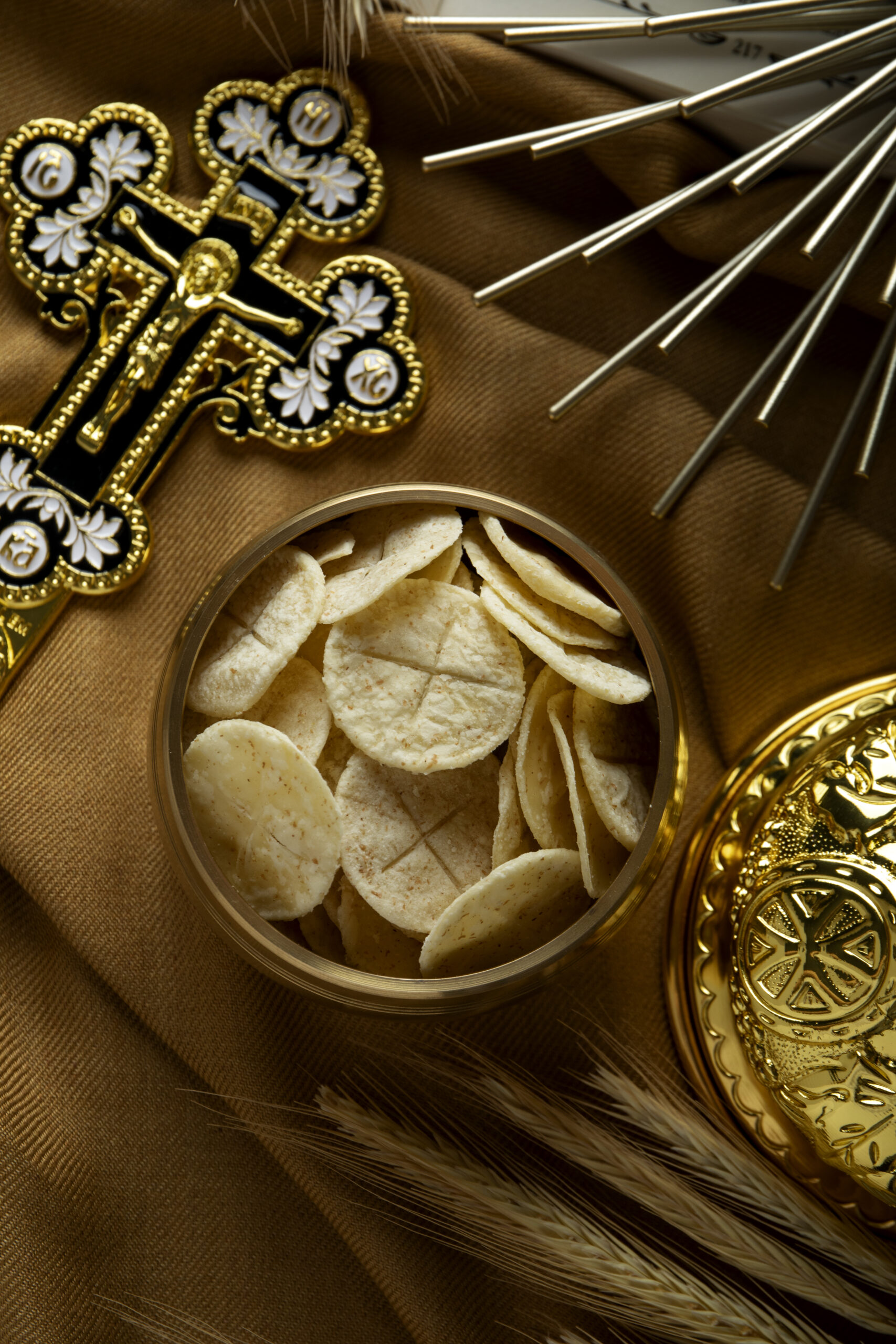
In the Catholic Religion, there is no sacrament as Holy and as important as the Eucharist. Of the seven sacraments, the Eucharist is the one that all the other sacraments point to and through the Eucharist, they come to complete fulfillment within the Christian soul. In this paper, we will consider each of these sacraments and how each one leads back to the Eucharist and its Christocentric nature.
We will begin with the sacraments of Christina initiation – Baptism, Confirmation, and then the Eucharist itself. These three sacraments not only make up the beginning of the Christian’s new life, but also are called upon and referenced throughout their entire livelihood.
Beginning with Baptism, we can already take great notice of how powerful this sacrament is, especially due to its sovereignty over original sin and how it releases us from the fall of our first parents, Adam and Eve, and brings us into a new life through the acts of the Holy Spirit. The word Baptize means to plunge, and when we are plunged into water through this holy act, we are symbolically participating in the death of Christ, and then also his resurrection when we are raised from the water, becoming a new creature, centered toward Christ and the grace of God. The CCC says in paragraph 1269, “Having become a member of the Church, the person baptized belongs no longer to himself, but to him who died and rose for us.” Baptism relates to the Eucharist in that through it, we receive our faith and are imitated into the community of believers, where we will prepare to one day receive Jesus Christ through communion of the Eucharist, leaning on the initial faith given to us from our baptism.
Confirmation is the next step after baptism and this sacrament is an initial measure of Christian maturity and readiness to confirm and proclaim one’s faith. Through the act of confirmation, we declare that we have considered seriously our faith, and profess to our community our belief and our desired adherence to live out and proclaim the gospel. The CCC says in paragraph 1303 that the effects of Confirmation can be listed as: 1) roots us more deeply in divine filiation, 2) it increases the gifts of the Holy Spirit in us, 3) it renders our bond with the Church more perfect, 4) it gives us a steadfast strength via the Holy Spirit to confess, proclaim, defend and not be ashamed of the Gospel. Confirmation, just like baptism, imprints a spiritual mark or indelible character on the Christian soul and it is this mark that identifies one as a follower of Christ. Then, it is the Eucharist that is the ultimate fulfillment of this confirmation in that through complete faith and grace from the Lord and the Holy Spirit, one can accept Christ into their bodies so that he may become united with them and grant them peace and health in their days until he comes again to resurrect all those worthy into the land of everlasting milk and honey, known as Heaven.
The Holy Eucharist completes the Christian initiation and although it goes without saying that the Eucharist points to itself, we’ll highlight some elements about the Eucharist that further strengthen our original argument. Paragraph 1324 from the CCC that summarizes it well saying, “The Eucharist is the source and summit of the Christian life. The other sacraments, and indeed all ecclesiastical ministries and works of the apostolate, are bound up with the Eucharist and are oriented towards it. For in the blessed Eucharist is contained the whole spiritual good of the Church, namely Christ himself, our Pasch.” To go further, Paragraph 1327 says, “… the Eucharist is the sum and summary of our faith: ‘Our way of thinking is attuned to the Eucharist, and the Eucharist in turn confirms our way of thinking.’”
The Holy Mass (missa) is another term for the Eucharist, and it is through this sacrament that the Christian person is filled with the Christ-like spirit, ready to be sent forth on the mission of proclaiming and living out the gospel in their everyday lives. (CCC 1332) The Eucharist was initiated to make us sharers in the new Passover, the death and resurrection of our Lord Jesus Christ, who commanded this of his disciples to carry out in memory of him.
Moving on from the sacraments of initiation, we come to the two sacraments of healing: Reconciliation and The Anointing of the Sick. We will begin with the Sacrament of Reconciliation, also called Penance, conversion, confession, and forgiveness. This sacrament is necessary because although we are born again through Christ in the initiation sacraments, we are still subject to concupiscence (the human nature’s inclination towards sin) and we receive forgiveness and absolution through this grace engendered in this Sacrament (CCC1426). I especially like the naming of this Sacrament as the sacrament of conversion, simply because this is what Jesus continually calls us to do, to convert ourselves to him by the strength of our faith and the grace of the Holy Spirit. When we admit our sins and resolve not to sin anymore, we reconcile ourselves with the Lord and our community, and can better live the Christian life now knowing our wrongs and how we can do better.
The CCC brings up a nice metaphor is paragraph 1456 at the council of Trent, saying, “for the sick person is too ashamed to show his wound to the doctor, the medicine cannot heal what it does not know” (CCC 1456). We must freely surrender ourselves to the sacrament, following its steps of contrition, confession and satisfaction. Importantly, the Church states that only those that are in a state of grace, meaning that they have confessed their mortal sins and received their penance and absolution, can receive the Holy Communion, the Eucharist. This is as to show the utmost respect for the Lord our God, Jesus Christ, and strive to be as clean and Holy as possible in order to receive his body and blood into our bodies. The CCC says that we can most certainly confess our even most venial sins, every day, if necessary, because this will help better form our conscience, and allow ourselves to be healed more regularly by the light of Christ in order to fight off temptation and evil tendencies (CCC 1448).
The anointing of the sick commends those who are ill to the suffering and glorified Lord, that he may raise them up and save them (CCC1499). When humans become ill, they have two choices, they can either become more self-absorbed and fearful, turning away from God, or become braver and more mature, turning towards God and discerning what path is the most essential and Holy in his life. The CCC makes the remark that very often illness provokes a search for God and a return to him (CCC 1501). The effects of this sacrament are many including, the uniting of the sick person to the passion of Christ, the strength and peace to endure the sickness or old age, the forgiveness of sins, the restoration of health, and the preparation for passing over to eternal life (CCC 1532). This sacrament relates back to the Eucharist in that it is usually paired with the Viaticum (the Eucharist) for those that are near the end of this life. This involves the subject receiving the Eucharist as they are about to pas over from this life to the next, after having received the full sacrament of the anointing. The CCC sums this connection up nicely when it reads in paragraph 1525, “ Thus, just as the sacraments of Baptism, Confirmation, and the Eucharist form a unity called ‘the sacraments of Christian initiation’, so too can it be said that penance, the Anointing of the sick and the Eucharist as viaticum constitute at the end of the Christian life ‘the sacraments that prepare for our heavenly homeland’ or the sacraments that complete the earthly pilgrimage (CCC 1525).
We move on to the sacraments directed toward the salvation of others: The Holy Orders and Matrimony. These are similar in that they both form an unbreakable bond with their partner. The Holy orders, comprised of episcopate, presbyterate, and diaconate degrees, all focus on becoming consecrated in Christ’s name, and permanently uniting oneself to the sole serving of its mate, the Church (except in the Diaconate case where man is married to his wife yet promises not to remarry after her death).
In the case of matrimony, God calls man and woman to love as his loves, and to fulfill this through matrimony, of which God is the author of (CCC 1603). Then love between a man and a woman, when aligned with the Holy Spirit and faith of our Lord, can be called a covenant that is drawn up into God’s covenant with man and helps both partners come to the fullness of the spiritual relationship with the Lord our God (CCC 1639). Both the Holy Orders and the Matrimony are celebrated in the Holy Mass, because the Eucharist is the memorial of the New Covenant and through this sacrament, the Bishop, Priest, Deacon and couple, unite themselves to the offering of the Christ for the Church, present in the Eucharistic sacrifice, so that they form but one body in Christ (CCC 1621).
As we can see after reviewing each of the sacraments, the proper place for each to be fully realized and revealed through the Eucharistic liturgy. The Eucharist is the WHY behind all of our sacraments, vocations, and beliefs. Through the partaking of the Holy Eucharist, we participate in the suffering of our Lord, as well as his glorious resurrection. Our spirits are made more Holy when we follow the sacraments presented by our Church and it is the sacrament of the Eucharist that binds and gives meaning to all the others, and additionally, it is by accepting the Eucharist in a state of grace, that the fruits from the Christians’ other sacramental participations, come to complete fulfillment and Holiness.
Bibliography
Vaticana, Libreria Editrice. 2000. Catechism of the Catholic Church. 2nd ed. USCCB.